

Loading
Multi-level validation ensures the SCM produces realistic, trustworthy results across a wide range of motorway scenarios.
A driver behaviour model can hardly be validated completely, ensuring that the model behaves in a realistic manner in each and every conceivable traffic scenario. However, the SCM has been validated at many different levels and in different traffic conditions and scenarios to ensure a simulation of motorway traffic that is as realistic as possible.
The validation of the SCM combines two aspects overall: traffic behaviour and individual driver behaviour. Traffic behaviour focuses on the analysis of all drivers in a traffic simulation and aims to show whether the overall macroscopic traffic and traffic parameters in simulation correctly represent real-world traffic. The aspect of individual driver behaviour answers the question of whether the driver behaviour model in the simulation correctly replicates the range of real-world driving behaviour in different microscopic situations.
Validation of the driver model in particular poses the challenge of defining the range of correct realistic driving behaviour, as this is both driver-related and situation-dependent and may therefore vary between different drivers within a situation that is objectively the same. To keep it simple: there is no driving behaviour within a simulation that is always "wrong".
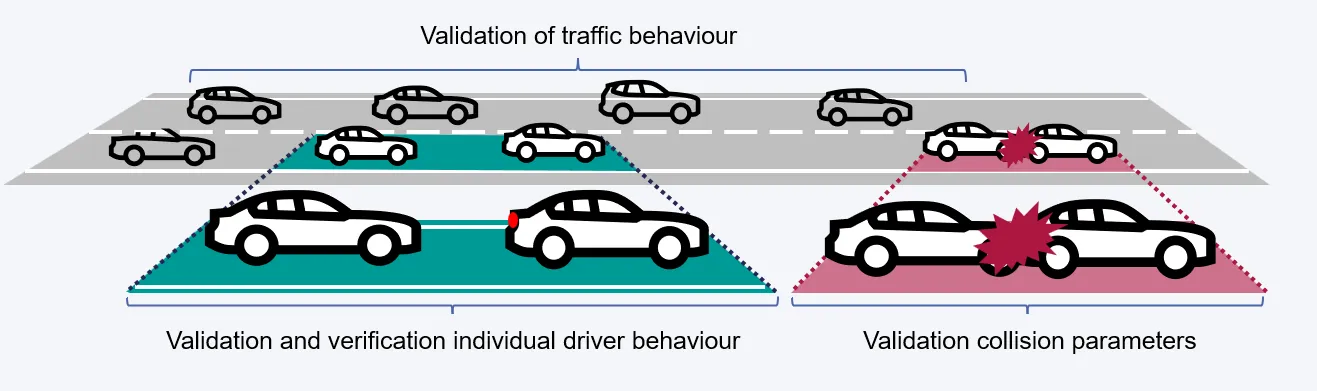
The SCM combines two complementary validation aspects: the behaviour of all drivers together and the behaviour of each individual driver.
Validation on traffic behaviour level seeks to answer the question of whether the overall traffic in simulation correctly represents real-world traffic. For this purpose, endurance simulations are performed with varying inputs such as traffic volume, number of lanes and the existence of any speed limit and specified parameters such as velocities, accelerations and time headways (THW) are compared to real-world data from FOTs or drone data sets.
The aspect of individual driver behaviour answers the question of whether the driver behaviour model in the simulation correctly replicates the range of real-world driving behaviour in different microscopic situations. For this purpose, basic driving situations such as free driving, approaching a slower vehicle, response to a speed limit sign and reaction in a defined critical scenario are analysed with only one agent simulated. Predefined parameters such as velocity, acceleration and reaction time are compared to criteria derived from real world data, such as FOTs and driving studies.
Validating a driver behaviour model poses a fundamental challenge: there is no single "correct" driving behaviour. The range of realistic behaviour is both driver-related and situation-dependent.
Consider a speed limit on a motorway section some drivers comply exactly, others exceed the limit. Both behaviours occur in reality. The SCM must produce this full distribution of behaviours to be considered valid, not a single deterministic response.
This is why stochastic parametrisation and population-level validation are central to the SCM methodology.