

Loading
Cognitive architecture, real-world data and stochastic modelling for realistic driver behaviour simulation.
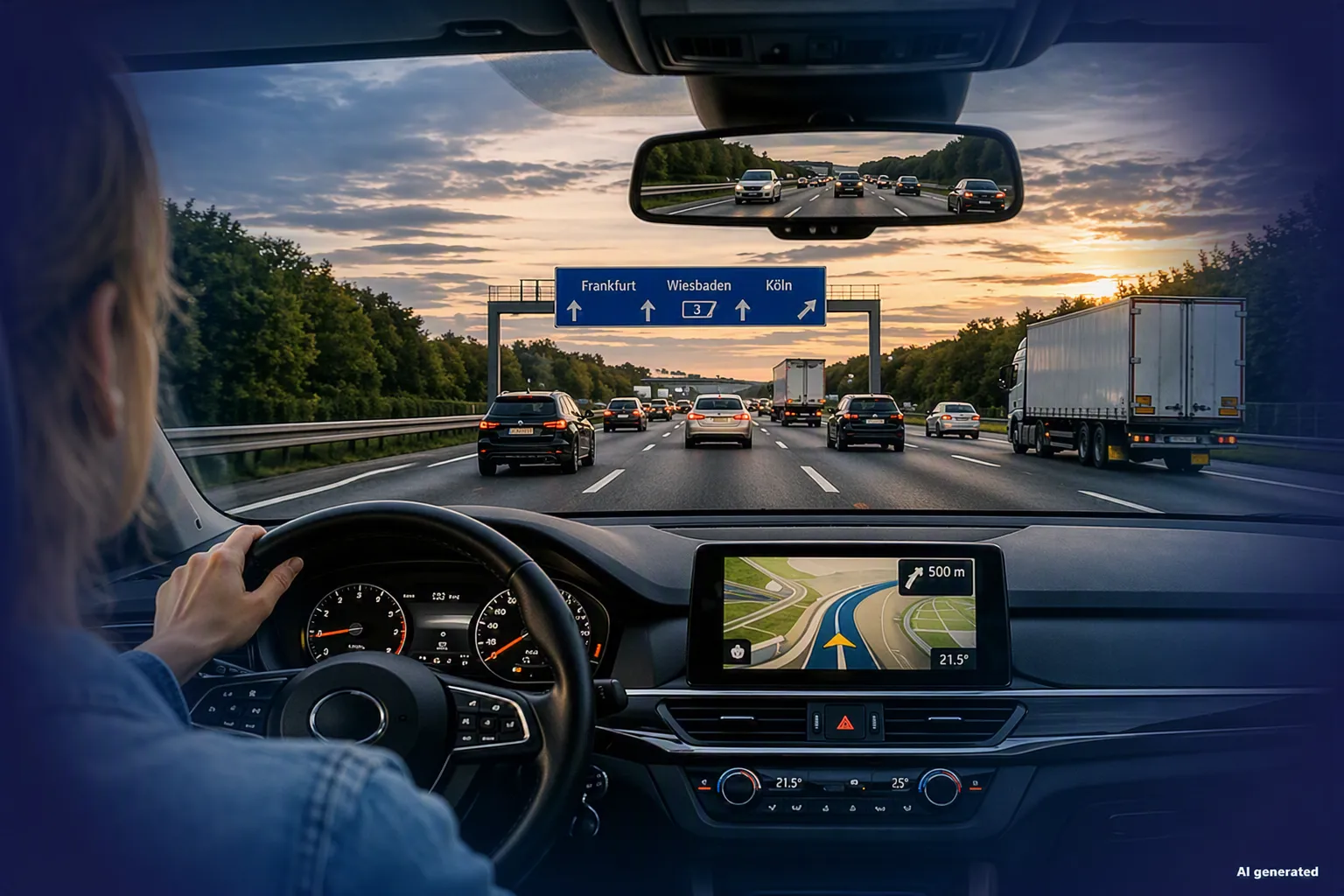
The objective of the Stochastic Cognitive Model, or SCM for short, is to ensure a realistic representation of traffic in the simulation in a wide range of different scenarios, both uncritical and critical, including possible collision scenarios. This is achieved by modelling cognitive processes and, based on this approach, ensuring realistic traffic interactions between virtual agents in both small and large numbers.
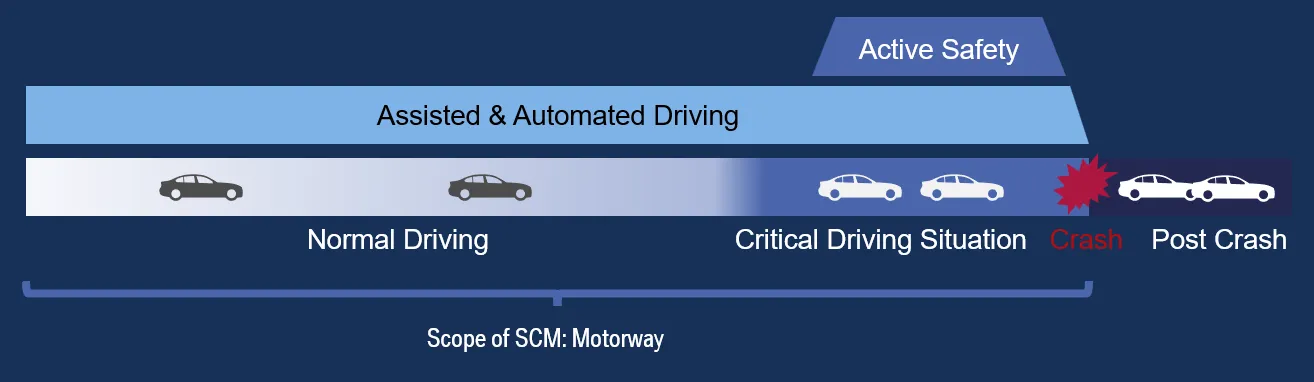
The SCM enables this realistic driver and traffic behaviour in motorway scenarios in multi-agent traffic simulations by modelling the driver's cognitive processes and combining these with stochastically distributed driver parameters. Cognitive processes include perception based on gaze behaviour, decision-making and reactions in all kinds of traffic scenarios. Finally, an important contribution to realistic simulation is the inclusion of intentional or unintentional human failure, whether perception-based or cognition-based.
Together with partners, BMW has been developing the Stochastic Cognitive Model since 2014. As a result of many years of development, the SCM has now achieved a release for motorway scenarios that enables a wide range of applications to assess the safety impact of automated driving systems. Currently, the SCM is designed to operate only on motorways. Enabling SCM for urban scenarios is planned, but it is still work in progress. Stay tuned!
The Stochastic Cognitive Model combines cognitive science with stochastic modelling for unparalleled realism.
Stochastic gaze distribution matrices modelling top-down and bottom-up visual attention based on naturalistic driving studies.

Internal environment model processing microscopic, mesoscopic and infrastructure information, handling incomplete perception like real drivers.
Stochastic situation recognition modelling real human variability in interpreting traffic situations.
Longitudinal and lateral action decisions converted to acceleration and curvature commands via vehicle dynamics.
Stochastically distributed parameters for perception, cognition and rule compliance creating a representative driver population.
Cars, trucks, buses and motorcycles are supported. Validation for additional vehicle types is in progress.
The application for which the Stochastic Cognitive Model was mainly developed is the virtual safety assessment of advanced driver assistance systems and automated driving systems. Within the approach of virtual safety assessment, traffic scenarios are generated stochastically. For the purpose of assessment in these scenarios, a sophisticated driver behaviour model such as the Stochastic Cognitive Model is required in order to obtain realistic trajectories for the vehicles involved in the scenario, from uncritical to critical scenarios and including potential collisions.
However, the Stochastic Cognitive Model actually has two roles to play in virtual safety assessment. First, in any assessment that involves a comparison between the technology (treatment condition) and the human driver (baseline condition), the SCM defines the baseline to which the technology is compared to. The second purpose of the driver model is to generate realistic surrounding traffic. As there are numerous interactions between the vehicle under test and the surrounding traffic, the realistic modelling of the latter is as important as the definition of the baseline by the SCM.
Real-world data is the foundation of the SCM's realism.
FOTs collecting gaze behaviour, reaction times and driver actions in real traffic.
Aerial imagery capturing microscopic and macroscopic traffic patterns.
Controlled experiments analysing driver reactions to sudden braking and lane changes.
In-depth accident databases (e.g. GIDAS) validating the SCM's accident representation.
Multi-level validation ensures trustworthy results.
Endurance simulations comparing velocities, accelerations and time headways against real-world FOT and drone data across varying traffic volumes, lanes and speed limits.
Single-agent analysis in basic scenarios comparing velocity, acceleration and reaction times to real-world experimental data.
The following scenarios illustrate the SCM in action across a range of motorway situations: from free-flow traffic to traffic jams and exit manoeuvres.
SCM Highway Traffic 3 Lanes
A motorway traffic scenario with three lanes is simulated. Multiple SCM agents drive on this motorway, constantly overtaking and switching lanes.
SCM Highway Traffic Urban Scenery
An SCM agent is shown driving through an urban landscape on a two-lane road, surrounded by traffic.
SCM Highway Traffic Overtaking and Switching Lane
An SCM agent drives through an urban landscape on a two-lane road, overtaking and switching lanes, surrounded by traffic.
SCM Highway Traffic Jam
An SCM agent on a motorway encounters the tail-end of a traffic jam.
SCM Highway Traffic Exit Scenario
SCM agents on a motorway pass by an exit lane, some of them signalling and preparing to exit.
SCM American Highway
An overview of a simulation showing American traffic with SCM.