

Loading
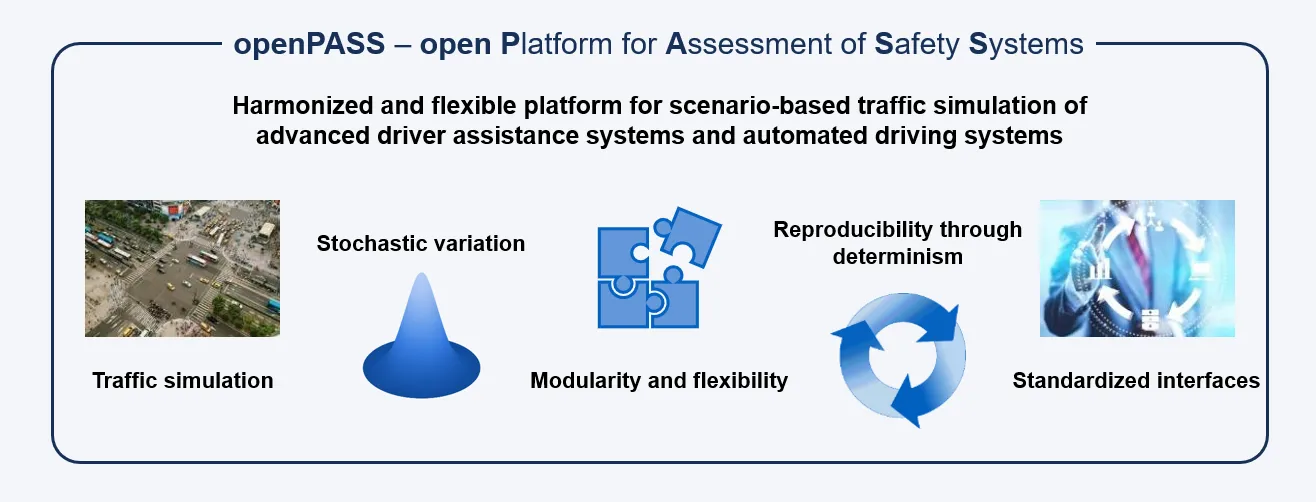
Harmonized and flexible platform for scenario-based traffic simulation of advanced driver assistance systems and automated driving systems.
The core vision and objectives behind the openPASS platform.
The rise of advanced driver assistance systems and automated driving systems leads to the need of virtual simulation to assess these systems and their effects.
Main agreed target objective is to become a broadly accepted effectiveness assessment platform for advanced driver assistance systems and automated driving systems.
How openPASS is applied in real-world simulation scenarios.


Key features and capabilities that make openPASS a powerful simulation platform.
Integration of advanced driver assistance systems and automated driving systems into openPASS.
Tool development through a unique collaboration between BMW, Bosch, Mercedes and Volkswagen.
Available for everyone under the Eclipse Public License v2.0.
Traffic simulation of highway, rural and urban scenarios.
Support of ASAM OpenDRIVE, OpenSCENARIO and OSI as well as Modelica FMI and SSP (supported in future).
Conducting thousands of simulations through stochastic variation.
Connection of user-defined components with the simulation core through a modular approach.
Reproducibility of simulation results through determinism.
Visualization of the simulation outputs in a 3D animation using Unity.